

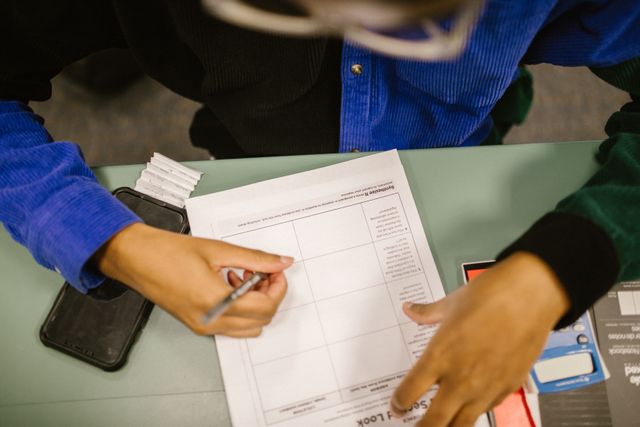
Traditional educational assessments frequently ask students to select the correct answer from a set of available options. Multiple-choice questions are widely used because they are easy to distribute, simple to evaluate, and capable of measuring knowledge across several topics within a limited period. However, selecting the correct answer does not always demonstrate that a student understands the underlying concept or can independently solve a problem. A learner might recognise the correct option through elimination, memorise a familiar pattern, or guess successfully without understanding why the other answers are incorrect.
An alternative assessment model could introduce a different responsibility: instead of simply identifying the correct answer, students would receive an incorrect solution and be required to repair it. They would examine the reasoning, identify the mistake, correct the relevant steps, and explain why the revised solution works. This approach transforms assessment from answer selection into active problem investigation. Students become responsible for understanding how an error occurred and how it can be corrected.
This introduces the concept of Repair-Based Learning, an educational approach in which learners develop knowledge by diagnosing and correcting intentionally flawed answers, calculations, explanations, code, procedures, or practical solutions. The objective is not to make learning unnecessarily difficult. It is to evaluate whether students can recognise incorrect reasoning, understand the source of a problem, and construct a reliable solution independently.
For an educational platform such as EasyShiksha, this approach creates opportunities to connect online courses, quizzes, worksheets, educational games, practical projects, and internships through a more advanced assessment experience. Instead of measuring only whether students can select the right answer, the platform could evaluate whether they understand mistakes, recover from them, and apply their knowledge to produce better outcomes. This could make learning more analytical, interactive, and closely connected to the problem-solving responsibilities students may encounter in professional environments.
Why Selecting the Correct Answer Does Not Always Demonstrate Understanding
Multiple-choice assessments are useful for evaluating specific areas of knowledge, but they have limitations when used as the primary method of measuring student understanding. A student who selects the correct answer may have arrived at it through genuine reasoning, but the same result could also come from guessing, memorising a familiar pattern, or eliminating obviously incorrect options.
Consider a programming question that asks students to identify the output of a JavaScript expression. A learner might select the correct output because they remember a similar example from a previous lesson. However, this does not necessarily prove that they understand how the expression is evaluated or how changing one condition would affect the result.
A similar problem occurs in mathematics. A student may recognise the correct numerical answer from four available options without understanding the calculation required to produce it. If the question changes slightly, the student may be unable to solve it independently.
Multiple-choice questions also provide limited information about the reasoning behind incorrect responses. If a student chooses the wrong option, the assessment may reveal that the answer is incorrect without identifying whether the problem involved a conceptual misunderstanding, a calculation error, a faulty assumption, or an incorrect sequence of steps.
Repair-based assessment addresses these limitations by requiring students to interact with the reasoning behind a solution. Instead of asking which answer is correct, the assessment presents a flawed attempt and asks the learner to investigate it. The student’s response reveals not only whether they know the correct answer but also whether they can recognise and explain the underlying problem.
Understanding Repair-Based Learning
Repair-Based Learning is an assessment and instructional approach in which students are presented with an incomplete, inaccurate, or intentionally incorrect solution and must improve it. The task may involve correcting a mathematical calculation, debugging a program, revising a scientific explanation, identifying an incorrect financial entry, or improving a project design.
The process begins with an existing solution that contains one or more errors. Students examine the information, compare the steps with relevant concepts, and determine where the reasoning becomes incorrect. They then revise the solution and provide an explanation of the changes.
The important distinction is that students are not simply asked to produce a correct answer from the beginning. They must understand an existing attempt and identify the relationship between the error and the final outcome. This requires analytical thinking, subject knowledge, attention to detail, and the ability to evaluate different approaches.
For example, a student studying HTML and CSS might receive a webpage containing incorrectly structured elements or styling rules that prevent the layout from displaying as intended. The task could require identifying the problem, correcting the code, and explaining why the original implementation failed.
A finance student might receive a financial calculation containing an incorrect formula. A science student might examine an explanation in which two scientific concepts have been confused. A digital marketing student might receive a campaign plan based on an incorrect interpretation of audience data.
In each case, learning becomes an active process of investigation and correction. Students develop an understanding of why a solution fails, how it can be improved, and how similar mistakes can be avoided in future tasks.
How the Repair-Based Assessment Process Works
A repair-based assessment can be designed around a structured sequence that connects error recognition with independent problem-solving. The first stage presents students with a solution that appears complete but contains a deliberate mistake. The error should be relevant to the learning objective and appropriate to the student’s current level.
The second stage requires the learner to inspect the solution and locate the incorrect element. Depending on the subject, this might involve examining a calculation, identifying a programming statement, reviewing a written explanation, or analysing a sequence of decisions.
The third stage involves diagnosing the error. Students must determine why the original approach is incorrect rather than simply replacing an answer with a different one. This is important because several mistakes may produce similar outcomes, and the correct repair depends on understanding the underlying cause.
The fourth stage requires students to modify the solution. They may rewrite a formula, correct a line of code, change an assumption, reorganise a process, or replace an inaccurate explanation. The revised version becomes the evidence of their understanding.
The final stage evaluates the explanation and the corrected result. Students should be able to describe what was wrong, why the correction was necessary, and how the revised solution satisfies the original requirement.
This structure can be adapted for different subjects and difficulty levels. Beginner assessments may contain one obvious error, while advanced challenges may include multiple connected mistakes that require students to examine the entire solution.
Applying Repair-Based Learning to Mathematics and Numerical Reasoning
Mathematics is particularly suitable for repair-based assessment because solutions generally involve a sequence of operations that can be examined individually. A final incorrect answer may result from a calculation mistake, an incorrect formula, a misunderstood condition, or an invalid assumption.
Traditional assessments may ask students to calculate the answer to a problem. A repair-based activity could instead provide a completed calculation in which one step is incorrect. The learner must identify the exact point where the reasoning fails and reconstruct the correct process.
For example, a student might receive a percentage calculation in which the original amount has been incorrectly used as the denominator. The task would require identifying the incorrect relationship, selecting the appropriate calculation, and explaining how the mistake changes the final result.
More advanced activities could involve algebraic equations, probability, statistics, geometry, or financial mathematics. Students could examine an incorrect proof, identify an invalid transformation, or correct a statistical interpretation that does not match the available data.
This method also helps distinguish different types of mathematical errors. A learner may understand the formula but make an arithmetic mistake. Another may calculate accurately but select an inappropriate formula. A third may misunderstand what the question is asking.
When EasyShiksha connects worksheets and quizzes through repair-based activities, students could practise these distinctions instead of repeatedly answering similar questions. The platform could provide progressively challenging examples that encourage students to understand the structure of mathematical reasoning.
Repairing Incorrect Programming Solutions Through Code Debugging
Programming provides one of the clearest practical applications of repair-based learning because software development regularly involves identifying and correcting errors. Professional developers do not simply write code that works on the first attempt. They examine unexpected behaviour, investigate the source of a problem, test possible corrections, and verify whether the revised implementation satisfies the requirements.
Students learning programming should therefore experience debugging as part of the learning process rather than treating it as an activity introduced only after completing theoretical lessons.
A beginner JavaScript assessment could present a function that contains an incorrect condition. Students would need to understand the expected behaviour, locate the faulty expression, correct the logic, and test the result. A more advanced exercise might involve an asynchronous function that handles a promise incorrectly or an event listener that does not respond as expected.
HTML and CSS activities could introduce broken page layouts, invalid element structures, missing attributes, or conflicting styling rules. Students would examine the implementation and make the necessary corrections to achieve the intended display.
The evaluation should consider more than whether the final code runs. Students should demonstrate that the correction addresses the original problem without introducing additional errors. Their explanations can reveal whether they understand the relevant programming concepts.
EasyShiksha could connect programming courses with repair-based coding quizzes, worksheets, and practical projects. A learner could first study a concept, then repair a short example, and eventually debug a larger application. This creates a progression from conceptual knowledge towards practical development skills.
Repairing Incorrect Scientific Explanations and Experimental Conclusions
Scientific education involves understanding relationships between observations, principles, assumptions, and evidence. Students may memorise scientific definitions and formulas without developing the ability to examine whether an explanation accurately represents a particular phenomenon.
Repair-based assessment can help students evaluate scientific reasoning. Instead of asking learners to select the correct definition, an activity could present an explanation containing an inaccurate scientific relationship. The learner would need to identify the misconception and replace it with an explanation supported by established principles.
For example, a physics student might receive an explanation that confuses velocity with acceleration. The task would require identifying the incorrect interpretation and describing how the two quantities differ. A chemistry student might examine a reaction explanation containing an incorrect assumption about the role of a reactant.
Biology assessments could involve repairing an explanation of a biological process in which the sequence of events has been incorrectly described. Environmental science activities might present a conclusion that does not follow from the observations provided.
The approach can also be extended to experimental design. Students might receive a laboratory procedure with an incorrect measurement step, an unsuitable control condition, or an unsupported conclusion. They would need to revise the procedure and explain how the correction improves the reliability of the experiment.
For EasyShiksha, repair-based science worksheets and quizzes could connect theoretical learning with analytical investigation. Students would practise evaluating explanations rather than simply memorising scientific statements.
Applying the Concept to Finance, Accounting, and Business Education
Financial and business education frequently involves calculations, records, interpretations, and decisions. An incorrect entry or assumption can influence subsequent results, making error detection an important professional capability.
A traditional accounting quiz might ask students to select the correct journal entry from several options. A repair-based activity could provide an incorrect entry and require the learner to identify the affected accounts, correct the debit and credit treatment, and explain the financial impact.
In spreadsheet-based finance activities, students might receive a formula that produces an inaccurate total because it references the wrong cells. The learner would need to examine the formula, identify the reference error, and correct the calculation.
Business education can also use repair-based challenges involving planning and decision-making. A student might receive a business proposal based on unrealistic assumptions about customer demand or operating costs. The task would require reviewing the assumptions, identifying weaknesses, and revising the proposal.
Digital marketing provides another relevant example. A learner could examine a campaign report in which performance has been interpreted incorrectly because impressions, clicks, and conversions have been confused. The student would need to correct the interpretation and explain which measurements are relevant to the campaign objective.
These activities can help students develop professional judgement by showing that incorrect assumptions can influence decisions even when calculations or documents appear well organised. EasyShiksha could integrate such challenges into finance, accounting, marketing, and business courses to help learners connect theoretical knowledge with workplace-oriented problem-solving.
Educational Games That Require Students to Repair Broken Solutions
Educational games can make repair-based learning more interactive by turning error correction into a sequence of challenges. Instead of presenting an incorrect answer on a static screen, a game could place students in an environment where they must identify problems, restore systems, correct decisions, or complete damaged processes.
A programming game might introduce a virtual application that has stopped functioning because of several incorrect instructions. Students would investigate the problem, repair the code, and test the application to restore its functionality.
A mathematics game could present a sequence of calculations in which one incorrect step causes later results to become unreliable. The learner would need to locate the original mistake rather than simply replacing the final answer.
A cybersecurity game could place students in a simulated digital environment containing incorrect security configurations. Students would identify weaknesses, repair the configuration, and evaluate whether the system now meets the required security conditions. Such activities should operate in controlled educational environments rather than involve unauthorised access to real systems.
Games could also introduce progressive complexity. Early levels might contain one visible error, while later levels could include multiple connected problems. Students would need to examine relationships between different components and determine which correction should be made first.
The game can provide immediate feedback, but it should not reveal the complete solution too quickly. Students should have opportunities to test their reasoning, receive hints, and revise unsuccessful attempts. EasyShiksha could use this approach to connect educational games with the concepts introduced in its online courses and quizzes.
Worksheets as Structured Error Investigation Environments
Worksheets are often used to provide additional practice after a lesson. However, they can become more powerful when designed around error investigation rather than repetitive answer production.
A repair-based worksheet could present students with a series of incorrect solutions that require different forms of reasoning. The questions may involve mathematical calculations, scientific explanations, programming logic, grammar, financial records, or data interpretation.
The important feature is that students must explain their corrections. A worksheet should not simply ask learners to replace an incorrect number or word. It should require them to identify the original mistake and describe why the revised approach is more accurate.
For example, a student learning English grammar might receive a paragraph containing incorrect tense usage and sentence structures. The learner would revise the paragraph while preserving its intended meaning. A computer science worksheet might contain a flawed algorithm, requiring the student to correct the sequence of instructions.
Worksheets can also be used to compare alternative solutions. Students may receive two attempts at the same problem, both containing different errors. They must determine which solution is closer to being correct and explain what remains to be repaired.
EasyShiksha could introduce worksheets that follow the structure of its online courses. A student completing a lesson could receive a related repair activity, allowing the platform to evaluate whether the learner can identify and correct common mistakes independently.
Building a Mistake Classification System
An advanced repair-based learning environment should distinguish between different categories of errors. Not all incorrect answers result from the same problem, and students require different forms of support depending on the underlying difficulty.
Conceptual errors occur when a learner misunderstands a fundamental principle. A student may believe that a particular mathematical operation follows a rule that does not apply to the given situation. In such cases, additional explanations and foundational practice may be necessary.
Procedural errors occur when a learner understands the concept but applies the steps in the wrong order or omits an important stage. These errors can often be addressed through structured exercises and repeated practice.
Calculation and execution errors involve incorrect arithmetic, typing mistakes, invalid syntax, or inaccurate data entry. Although these mistakes may appear minor, they can influence the entire outcome of a solution.
Reasoning errors involve unsupported assumptions, incorrect conclusions, or weak connections between evidence and interpretation. These are particularly important in scientific, financial, and analytical subjects.
A mistake classification system could help EasyShiksha understand the kinds of errors students repeatedly make. Instead of recording only an incorrect answer, the platform could identify whether the student needs conceptual clarification, procedural practice, technical debugging, or stronger analytical reasoning.
The classification should remain evidence-based. A single incorrect response should not be sufficient to label a student as having a particular weakness. Patterns across multiple activities provide a more reliable basis for identifying learning needs.
Measuring More Than the Final Correct Answer
One of the most important advantages of repair-based assessment is that it creates opportunities to evaluate the process through which students reach a solution. A conventional assessment may record only the final answer, while a repair activity can reveal how students investigate and correct a problem.
The first important measure is error identification. Can the student locate the incorrect part of the solution? A learner who recognises the precise source of an error demonstrates a different capability from someone who simply changes the final answer.
The second measure is diagnostic reasoning. Can the student explain why the original approach failed? This reveals whether the learner understands the concept behind the correction.
The third measure is correction quality. Does the revised solution satisfy the original requirements? Students should be evaluated on whether their changes genuinely resolve the problem rather than merely replacing one incorrect result with another.
The fourth measure is explanation. Can the student communicate the reasoning behind the correction clearly? This is important because professional work often requires people to explain technical decisions to colleagues, clients, supervisors, or other stakeholders.
Another useful measure is independent recovery. Students may initially require hints or guidance, but they should gradually become capable of diagnosing similar problems without assistance. The platform can examine whether learners are becoming more independent across repeated activities.
For EasyShiksha, these measurements could provide a richer understanding of student development than conventional right-or-wrong scoring. They can also help educators identify whether students are improving in analytical thinking and practical problem-solving.
Connecting Repair-Based Assessment With Online Courses and Certificates
Repair-based learning can become more effective when it is integrated directly into online course structures. Rather than introducing error correction as a separate activity, each course module could include challenges that require students to repair examples related to the concepts they have just studied.
A beginner programming course might introduce variables and conditions through lectures before presenting small debugging exercises. Later modules could include more complex tasks involving functions, arrays, events, and asynchronous programming. A final project could require students to examine and improve an existing application.
A finance course could introduce accounting principles, followed by activities in which learners correct financial entries and spreadsheet formulas. A marketing course could include challenges involving inaccurate audience analysis, incorrect campaign measurements, and poorly structured content strategies.
This approach also changes the meaning of course completion. A student would not be evaluated only on whether the lessons were completed. The platform could examine whether the learner can apply concepts through quizzes, worksheets, repair exercises, and practical projects.
Certificates could communicate the scope of the learning experience more clearly when supported by relevant assessment records. They should distinguish between course participation and demonstrated capabilities rather than implying that every student who completes a course has mastered all associated skills.
EasyShiksha could use repair-based assessments as an additional learning component within its online courses, allowing students to develop analytical capabilities alongside subject knowledge.
Using Artificial Intelligence to Generate and Evaluate Repair Challenges
Artificial intelligence can support repair-based learning by helping educators generate different versions of flawed solutions, analyse student corrections, and recommend suitable follow-up activities. This is particularly useful when a platform serves learners across multiple subjects and difficulty levels.
An AI-supported system could generate several incorrect programming examples based on the same concept. One version might contain an incorrect condition, another might include a logical error, and a third might use an unsuitable data structure. Students could receive different challenges while working towards the same learning objective.
AI could also help identify patterns in student mistakes. If a learner repeatedly corrects syntax errors but struggles with logical conditions, the system could recommend additional exercises focused on reasoning. If a student makes similar calculation mistakes across different worksheets, the platform could introduce targeted numerical practice.
Another application involves adaptive difficulty. Students who successfully repair simple errors could progress to more complex challenges involving multiple connected mistakes. Learners who require additional support could receive hints, explanations, or simpler examples.
However, AI-generated corrections must be reviewed carefully. Some problems may have more than one valid solution, particularly in programming, writing, design, and project development. Automated evaluation should recognise alternative approaches when they satisfy the task requirements. Educators should remain involved in evaluating complex reasoning and creative solutions.
For EasyShiksha, AI could make repair-based activities more scalable and personalised, provided that the system maintains reliable answer validation, clear evaluation criteria, and appropriate human oversight.
Connecting Repair-Based Learning With Projects and Internships
The value of error correction extends beyond quizzes and worksheets. Real projects frequently involve incomplete information, unexpected behaviour, technical failures, and changing requirements. Students who learn how to diagnose and repair incorrect solutions may be better prepared to handle these situations.
A web development project could require students to improve an existing website containing layout problems, broken links, or incorrect JavaScript behaviour. Instead of starting with a blank project, learners would examine the existing implementation and make improvements.
A data analytics project might provide a dataset containing inconsistent entries, missing values, or inaccurate calculations. Students would need to identify the issues, correct the data, and explain how the corrections influence the final analysis.
During internships, students may encounter tasks involving previously developed systems, reports, or processes. They may need to investigate an issue, understand the existing work, and suggest an appropriate improvement. Repair-based learning introduces students to this style of problem-solving before they enter a professional environment.
EasyShiksha could connect repair-based exercises with practical project assignments and internship preparation. Students could progress from correcting small examples to improving complete solutions, gradually developing the ability to analyse existing work and contribute meaningful changes.
This progression is particularly valuable because professional responsibilities do not always involve creating something entirely new. Many roles require people to review, maintain, troubleshoot, improve, and correct existing systems.
Challenges in Introducing Repair-Based Learning
Although repair-based assessment offers several educational advantages, it requires thoughtful design. One major challenge is ensuring that intentionally incorrect solutions are realistic and relevant. If errors are too obvious, students may identify them without meaningful reasoning. If they are too complex, beginners may become confused or discouraged.
Another challenge is avoiding ambiguity. A solution should not be marked incorrect simply because it differs from the method preferred by the educator. In subjects such as mathematics, programming, and writing, multiple valid approaches may exist. Assessment criteria must focus on correctness, reasoning, and whether the solution meets the requirements.
Evaluation can also require more effort than conventional multiple-choice scoring. A student may identify the correct error but explain it poorly, or propose an alternative solution that is technically valid. Automated systems must be designed to recognise these differences, and complex submissions may require human review.
There is also a risk that students may become focused on correcting errors without developing the ability to create original solutions. Repair-based learning should therefore complement traditional problem-solving, creative assignments, research, and independent projects rather than replace them.
Finally, feedback must be constructive. Students should understand why an attempted correction was unsuccessful and receive guidance that helps them improve. Repeatedly showing that a solution is wrong without explaining the underlying issue can create frustration rather than learning.
A balanced implementation should combine repair challenges with explanations, practical exercises, independent problem-solving, and opportunities to demonstrate original work.
The Future of Assessment: From Answer Selection to Solution Reconstruction
The future of educational assessment may move towards more interactive and process-oriented evaluation. Instead of asking only whether students can identify the correct answer, platforms could increasingly examine whether they can investigate incomplete information, recognise errors, reconstruct solutions, and justify decisions.
This shift reflects the nature of modern professional work. Developers debug applications, analysts correct data inconsistencies, accountants review financial records, researchers evaluate experimental results, and marketing professionals revise campaigns when performance does not match expectations. In each situation, the ability to identify and correct mistakes is an important professional capability.
For EasyShiksha, repair-based learning could connect its educational ecosystem through a common problem-solving approach. Online courses could introduce concepts, quizzes could present flawed answers, worksheets could provide structured correction exercises, games could create interactive repair challenges, and projects could require students to improve more complex solutions. Internships could then provide opportunities to apply these capabilities in workplace-oriented tasks.
This approach could also support a stronger understanding of student progress. A learner who initially struggles to identify mistakes but gradually becomes capable of diagnosing and correcting complex solutions demonstrates meaningful development. The platform could use this evidence to recommend suitable advanced courses, practical assignments, and internship opportunities.
Education would become less focused on the ability to reproduce an expected answer and more focused on the ability to understand, evaluate, and improve solutions.
Conclusion
Asking students to repair an incorrect solution instead of simply selecting the correct answer introduces a more analytical approach to education. It requires learners to investigate errors, understand the reasoning behind them, construct corrections, and explain why the revised solution is valid. This process can reveal capabilities that conventional assessments may overlook, including debugging, critical thinking, diagnostic reasoning, and independent problem-solving.
For EasyShiksha, repair-based learning offers an opportunity to connect online courses, quizzes, worksheets, educational games, practical projects, and internships through a common approach to skill development. Students can progress from correcting simple mistakes in individual exercises to improving complex solutions in practical assignments and workplace-oriented environments.
The objective is not to eliminate multiple-choice questions or traditional examinations. These methods continue to serve important educational purposes. Instead, repair-based assessment can complement existing methods by evaluating how students respond when something goes wrong. A learner who can recognise an error, understand its cause, and produce a reliable correction demonstrates a valuable form of knowledge: the ability to use learning to improve outcomes rather than simply identify an expected answer.