

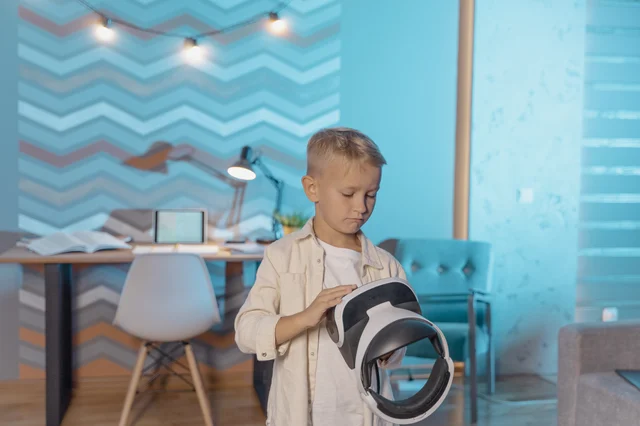
Education has continuously evolved alongside technological advancements. From traditional classrooms and printed textbooks to digital learning platforms and artificial intelligence-powered educational tools, technology has consistently transformed how students acquire knowledge and develop skills. Among the most innovative technologies reshaping modern education is Virtual Reality (VR), a powerful tool that creates immersive and interactive learning experiences.
Virtual Reality enables learners to enter digitally simulated environments that replicate real-world settings or create entirely new experiences. Instead of simply reading about a historical monument, scientific concept, or engineering process, students can virtually explore, interact, and engage with these subjects in a highly realistic and immersive manner. This shift from passive learning to experiential learning has significant implications for student engagement, knowledge retention, and educational outcomes.
As online education continues to expand, educational platforms are exploring innovative methods to make learning more interactive and effective. Platforms such as EasyShiksha have already transformed education by providing accessible, flexible, and skill-oriented learning opportunities. The integration of emerging technologies like Virtual Reality presents exciting possibilities for further enhancing digital education and creating more engaging learning environments.
Virtual Reality is no longer limited to gaming and entertainment. It is increasingly being adopted across industries such as healthcare, engineering, aviation, military training, and education. By providing realistic simulations and immersive experiences, VR helps learners understand complex concepts, practice skills safely, and engage more deeply with educational content.
This article explores the fundamentals of Virtual Reality, its role in modern education, key applications in learning environments, benefits and challenges, future trends, and how platforms like EasyShiksha can contribute to the advancement of immersive digital learning.
Understanding Virtual Reality
Virtual Reality is a computer-generated technology that creates simulated environments capable of immersing users in interactive digital experiences. Through specialized devices such as VR headsets and motion-tracking systems, users can explore virtual spaces that respond to their movements and actions.
Unlike traditional learning methods that rely primarily on reading, listening, or viewing static content, Virtual Reality engages multiple senses simultaneously. Learners can interact with objects, navigate environments, and experience scenarios that closely resemble real-life situations.
The immersive nature of VR creates a sense of presence, making users feel as though they are physically present within the virtual environment. This level of engagement enhances learning by transforming abstract concepts into tangible experiences.
For students, Virtual Reality offers opportunities to move beyond conventional educational boundaries and participate actively in the learning process.
The Evolution of Technology in Education
Education has witnessed remarkable technological advancements over the past few decades. The introduction of computers, internet connectivity, online learning platforms, digital libraries, and mobile applications has significantly expanded access to knowledge.
The rise of online learning platforms such as EasyShiksha has further democratized education by enabling learners to access courses, certifications, and educational resources regardless of geographical location. These platforms have empowered students to learn at their own pace and according to their individual needs.
Virtual Reality represents the next stage in this evolution. Rather than simply digitizing educational content, VR transforms how students interact with information by creating immersive and experiential learning environments.
As educational institutions and online learning providers continue embracing innovation, Virtual Reality is becoming an increasingly valuable tool for enhancing engagement and improving learning outcomes.
Why Virtual Reality Matters in Learning
Traditional educational methods often rely heavily on theoretical explanations and passive information consumption. While these approaches can be effective, some concepts are difficult to understand without practical experience or visualization.
Virtual Reality addresses this challenge by allowing students to experience learning rather than merely observe it. Learners can explore environments, manipulate objects, and engage directly with educational content.
This experiential approach improves understanding and promotes active participation. Students become more involved in the learning process, which often leads to increased motivation and better retention of information.
Virtual Reality is particularly valuable for subjects that involve complex processes, spatial relationships, or practical skills. By creating realistic simulations, VR bridges the gap between theory and application.
Enhancing Student Engagement Through Immersion
Student engagement is a critical factor in academic success. Learners who are actively engaged tend to demonstrate higher levels of concentration, motivation, and achievement.
Virtual Reality enhances engagement by creating immersive experiences that capture students’ attention and stimulate curiosity. Instead of passively consuming information, learners become active participants within educational scenarios.
For example, students studying ancient civilizations can virtually explore historical cities, interact with cultural artifacts, and observe historical events in realistic settings. Such experiences make learning more memorable and meaningful.
This increased engagement helps reduce distractions and encourages deeper exploration of subject matter, resulting in more effective educational outcomes.
Virtual Reality in Science Education
Science subjects often involve concepts that are difficult to visualize through traditional teaching methods. Topics such as molecular structures, human anatomy, astronomical systems, and chemical reactions can be challenging for students to fully comprehend.
Virtual Reality enables learners to explore these concepts in three-dimensional environments. Students can observe biological systems from within, manipulate molecular models, and travel through virtual representations of the solar system.
These immersive experiences improve conceptual understanding by allowing learners to interact directly with scientific phenomena. Complex processes become easier to understand when students can observe them from multiple perspectives and engage with them actively.
Such applications demonstrate the transformative potential of VR in science education.
Transforming Medical and Healthcare Training
Medical education requires extensive practical experience and skill development. Traditionally, students gain hands-on experience through laboratories, simulations, and clinical practice.
Virtual Reality enhances medical training by providing realistic simulations that allow learners to practice procedures in safe and controlled environments. Students can perform virtual surgeries, study anatomy interactively, and develop clinical decision-making skills without risking patient safety.
These immersive learning experiences improve confidence, competence, and preparedness among future healthcare professionals.
As technology advances, Virtual Reality is expected to play an increasingly important role in medical and healthcare education worldwide.
Virtual Reality in Engineering and Technical Education
Engineering and technical disciplines often involve complex systems, machinery, and design processes. Understanding these concepts can be challenging when relying solely on textbooks and diagrams.
Virtual Reality enables students to interact with virtual models of equipment, structures, and engineering systems. Learners can explore designs, conduct simulations, and observe operational processes in realistic environments.
This hands-on approach improves technical understanding and supports practical skill development. Students gain valuable experience without requiring access to expensive physical equipment or specialized facilities.
The ability to practice and experiment safely contributes to more effective learning and stronger professional preparation.
Supporting Skill-Based Learning
Modern education increasingly emphasizes skill development alongside theoretical knowledge. Employers seek individuals who possess practical abilities and problem-solving competencies in addition to academic qualifications.
Virtual Reality supports skill-based learning by providing realistic environments for practice and experimentation. Students can develop communication, leadership, technical, and decision-making skills through immersive simulations.
These experiences allow learners to apply knowledge in practical contexts, strengthening both competence and confidence.
Online learning platforms such as EasyShiksha focus on helping students acquire valuable skills for academic and professional success. The future integration of immersive technologies could further enhance these learning opportunities.
Personalized Learning Experiences
Every student learns differently. Some individuals benefit from visual explanations, while others prefer hands-on experiences or interactive activities.
Virtual Reality supports personalized learning by offering adaptable educational experiences tailored to individual preferences and learning styles. Students can progress at their own pace, revisit challenging concepts, and engage with content in ways that best suit their needs.
Personalized learning environments improve understanding and encourage greater learner autonomy. Students become more actively involved in managing their educational journeys.
This learner-centered approach aligns closely with the principles of modern online education and contributes to improved academic outcomes.
Virtual Reality and Distance Education
Distance education has become increasingly important in recent years, particularly with the growth of online learning platforms. However, remote learning can sometimes lack the interactivity and engagement associated with traditional classroom experiences.
Virtual Reality addresses this challenge by creating immersive virtual classrooms where students can interact with instructors, peers, and educational content in real time.
Learners can participate in collaborative projects, attend virtual lectures, and explore educational simulations regardless of physical location. This enhances social interaction and creates more engaging online learning environments.
Platforms like EasyShiksha have already expanded access to education through digital technologies. The integration of Virtual Reality could further enrich remote learning experiences and strengthen learner engagement.
Improving Knowledge Retention
Knowledge retention is a major objective of effective education. Students often forget information that is learned passively or lacks meaningful engagement.
Research suggests that immersive and experiential learning experiences can significantly improve retention rates. Virtual Reality enhances memory by involving learners in active exploration and interaction.
When students experience concepts firsthand, they are more likely to remember and understand them. The emotional and sensory engagement associated with VR contributes to stronger memory formation and long-term recall.
This makes Virtual Reality a valuable tool for promoting deeper and more durable learning.
Challenges of Implementing Virtual Reality in Education
Despite its many benefits, Virtual Reality faces several challenges in educational settings. One of the primary barriers is cost. High-quality VR hardware and software can require significant investment, making widespread adoption difficult for some institutions.
Technical infrastructure is another consideration. Reliable internet connectivity, compatible devices, and technical support are necessary for effective VR implementation.
Educators may also require training to integrate Virtual Reality into curricula effectively. Developing high-quality educational content suitable for immersive learning environments can be time-consuming and resource-intensive.
Additionally, some users may experience discomfort or motion-related issues during prolonged VR sessions.
Addressing these challenges will be important for ensuring that Virtual Reality becomes accessible and beneficial to a broader range of learners.
The Future of Virtual Reality in Education
The future of Virtual Reality in education is highly promising. As technology becomes more affordable and accessible, adoption is expected to increase across schools, universities, and online learning platforms.
Advancements in hardware, software, artificial intelligence, and connectivity will likely enhance the realism and effectiveness of virtual learning environments. Students may soon experience highly personalized educational journeys that adapt dynamically to their progress and learning needs.
Emerging technologies such as augmented reality, mixed reality, and artificial intelligence may further complement Virtual Reality, creating integrated educational ecosystems that combine immersive experiences with intelligent learning support.
These developments have the potential to transform education on a global scale.
How EasyShiksha Can Benefit from Virtual Reality Integration
EasyShiksha has established itself as a platform that promotes accessible, flexible, and skill-oriented learning. As educational technology continues to evolve, Virtual Reality presents exciting opportunities for enhancing learner engagement and educational effectiveness.
The integration of immersive simulations, virtual laboratories, interactive demonstrations, and experiential learning environments could enrich course offerings and provide students with more practical learning experiences.
Virtual Reality could help EasyShiksha learners explore complex concepts, develop professional skills, and engage more deeply with educational content. Such innovations would further strengthen the platform’s commitment to empowering students through modern and accessible education.
By embracing emerging technologies, EasyShiksha can continue contributing to the future of digital learning and educational excellence.
Conclusion
Virtual Reality is transforming learning environments by introducing immersive, interactive, and experiential educational experiences. Its ability to engage students, enhance understanding, improve retention, and support practical skill development makes it one of the most promising technologies in modern education.
From science and healthcare training to engineering, skill development, and distance learning, Virtual Reality offers innovative solutions to many educational challenges. Although barriers such as cost and infrastructure remain, ongoing technological advancements are steadily expanding access to immersive learning opportunities.
Online learning platforms such as EasyShiksha have already demonstrated the power of digital education in making knowledge more accessible and flexible. The future integration of Virtual Reality technologies has the potential to further revolutionize online learning by creating engaging environments that combine convenience with experiential learning.
As education continues evolving in response to technological innovation, Virtual Reality will likely play an increasingly important role in shaping how students learn, interact, and prepare for future careers. For learners, educators, and platforms like EasyShiksha, embracing Virtual Reality represents an exciting step toward a more dynamic, interactive, and effective educational future.