

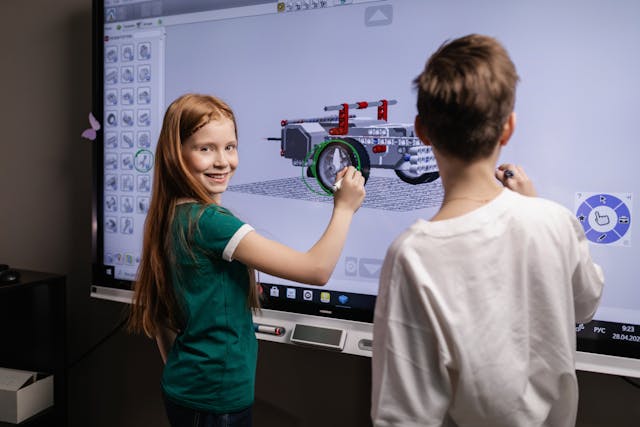
Teaching children math and science can sometimes be challenging. Many young learners initially perceive these subjects as difficult, abstract, or even intimidating. Traditional teaching approaches that rely heavily on memorization, repetitive exercises, and rigid classroom structures often fail to spark curiosity or enthusiasm among children. However, when math and science are presented in engaging, creative, and Interactive Learning , they can become some of the most exciting subjects for young minds.
Modern educational platforms such as EasyShiksha and Edspectra are transforming how children learn complex subjects. By integrating technology, gamification, hands-on activities, and interactive learning modules, these platforms help students understand mathematical and scientific concepts in a fun and meaningful way.
Children naturally possess curiosity and a desire to explore the world around them. When educators and parents harness that curiosity through engaging teaching methods, math and science become tools for discovery rather than subjects to fear. This article explores effective and fun strategies for teaching kids math and science while highlighting how digital learning platforms like EasyShiksha and Edspectra can enhance the learning experience.
The Importance of Making Math and Science Fun
Math and science are foundational subjects that influence a child’s cognitive development, logical reasoning, and problem-solving abilities. However, many children develop anxiety toward these subjects at an early age due to traditional teaching approaches that emphasize correctness over exploration.
Making these subjects enjoyable helps students:
-
Develop curiosity and a love for learning
-
Build strong analytical and reasoning skills
-
Improve confidence in problem-solving
-
Strengthen creativity and innovation
-
Prepare for future careers in technology and science
Platforms like EasyShiksha and Edspectra focus on interactive learning models, ensuring that children learn through exploration, experimentation, and practical applications rather than passive memorization.
Encouraging Curiosity Through Interactive Learning
Children learn best when they actively participate in the learning process. Interactive activities encourage them to ask questions, test ideas, and discover answers independently.
Digital learning platforms such as EasyShiksha offer interactive courses, animated lessons, and quizzes designed specifically for young learners. These tools help transform traditional subjects into engaging experiences.
Some effective ways to encourage curiosity include:
-
Asking open-ended questions
-
Allowing children to experiment with ideas
-
Encouraging exploration and observation
-
Supporting creative problem-solving
When children feel free to explore concepts without fear of making mistakes, their interest in math and science naturally grows.
Learning Through Educational Games
Gamification has become one of the most powerful tools in modern education. Educational games introduce competition, rewards, and interactive challenges that make learning enjoyable.
Math and science games can help children practice concepts such as:
-
Arithmetic operations
-
Logical reasoning
-
Pattern recognition
-
Scientific experimentation
Platforms like EasyShiksha incorporate quizzes, puzzles, and reward-based activities that motivate students to engage consistently with learning material.
Gamified learning offers several benefits:
-
Increased engagement and participation
-
Improved concentration and retention
-
Development of problem-solving skills
-
Enhanced motivation to learn
By transforming lessons into games, educators can create a positive and exciting learning environment.
Hands-On Experiments for Science Learning
Science becomes much more exciting when children can see theories come to life through experiments. Hands-on activities allow students to observe scientific principles in action, making abstract concepts easier to understand.
Simple experiments that children can perform at home or in the classroom include:
-
Creating volcano models using baking soda and vinegar
-
Growing plants to understand photosynthesis
-
Building simple circuits to learn about electricity
-
Observing water evaporation and condensation
These experiments encourage children to develop scientific thinking by asking questions, forming hypotheses, and observing results.
Online learning platforms such as Edspectra often provide guided experiment tutorials that help children explore science safely and effectively.
Using Storytelling to Teach Concepts
Storytelling is a powerful educational tool that can make complex ideas more relatable and memorable for children. By presenting math and science concepts within stories, educators can capture students’ imagination and enhance understanding.
For example:
-
A story about astronauts exploring space can introduce physics and astronomy concepts.
-
A tale about treasure hunting can involve solving mathematical puzzles.
-
A narrative about inventors can inspire curiosity about scientific discoveries.
Story-based learning helps children visualize concepts and connect them to real-life situations.
Educational platforms like EasyShiksha often integrate storytelling with animated lessons to make learning more engaging for young students.
Incorporating Technology in Learning
Technology has revolutionized the way children access education. Interactive videos, simulations, and virtual labs make it easier for students to explore complex topics in a visually appealing way.
Some technological tools that support fun learning include:
-
Interactive educational apps
-
Virtual science experiments
-
Online quizzes and challenges
-
Animated learning modules
Platforms such as EasyShiksha provide structured online courses that combine technology with practical learning experiences.
By integrating technology into education, students can learn at their own pace while staying motivated and curious.
Learning Math Through Real-Life Applications
Children often struggle with math because they cannot see how it applies to real life. Demonstrating practical applications helps them understand its importance.
Examples include:
-
Using cooking recipes to teach measurements and fractions
-
Managing small allowances to learn budgeting and arithmetic
-
Playing board games that involve counting or probability
-
Measuring distances while playing outdoor games
Real-life applications make mathematical concepts meaningful and relevant.
Online learning platforms like EasyShiksha encourage real-world problem-solving exercises that help students develop practical math skills.
Collaborative Learning and Group Activities
Children often learn more effectively when they collaborate with peers. Group activities encourage teamwork, discussion, and shared problem-solving.
Examples of collaborative activities include:
-
Group science projects
-
Math puzzle competitions
-
STEM challenges
-
Robotics and coding clubs
These activities help children develop communication skills while reinforcing academic concepts.
Digital platforms such as Edspectra also support collaborative learning through virtual classrooms and discussion forums.
Encouraging Creative Thinking in STEM
Science and mathematics are not just about formulas and theories—they also require creativity and imagination. Encouraging creative thinking helps children approach problems from different perspectives.
Creative STEM activities may include:
-
Designing simple machines
-
Building structures with blocks or LEGO
-
Creating science models
-
Coding simple games or animations
By combining creativity with technical knowledge, children develop innovative thinking skills that are essential for future careers.
Role of Parents and Teachers in Making Learning Fun
Parents and teachers play a crucial role in shaping children’s attitudes toward math and science. Their encouragement, patience, and support can significantly influence a child’s confidence and interest in these subjects.
Some ways adults can support fun learning include:
-
Creating a positive learning environment
-
Encouraging questions and curiosity
-
Celebrating effort and progress
-
Providing access to educational resources
Platforms like EasyShiksha offer structured courses that parents and teachers can use to supplement classroom learning.
Benefits of Fun-Based Learning Approaches
Teaching math and science through engaging methods offers numerous advantages for young learners.
Key benefits include:
-
Improved academic performance
-
Higher levels of curiosity and creativity
-
Stronger problem-solving abilities
-
Increased confidence in learning complex subjects
-
Greater interest in STEM careers
When children associate learning with enjoyment and exploration, they develop a lifelong love for knowledge.
Preparing Children for the Future
The modern world increasingly relies on science, technology, engineering, and mathematics (STEM). Careers in fields such as artificial intelligence, robotics, biotechnology, and data science require strong analytical skills and scientific understanding.
By making math and science fun and engaging during early education, platforms like EasyShiksha and Edspectra help prepare children for these future opportunities.
Encouraging curiosity and innovation at a young age ensures that students develop the skills needed to thrive in a rapidly evolving global environment.
Conclusion
Teaching children math and science does not have to be a difficult or stressful experience. When educators and parents adopt creative and interactive approaches, these subjects can become exciting journeys of discovery and exploration.
By incorporating educational games, hands-on experiments, storytelling, real-life applications, and modern technology, children can develop a deeper understanding of mathematical and scientific concepts.
Innovative platforms like EasyShiksha and Edspectra are playing a crucial role in transforming traditional education by offering engaging digital learning experiences that combine fun with academic excellence.
Ultimately, the goal of teaching math and science is not only to help children perform well in school but also to nurture curiosity, creativity, and critical thinking. When learning becomes enjoyable, children develop a lifelong passion for discovery and innovation—skills that will empower them to shape the future.