

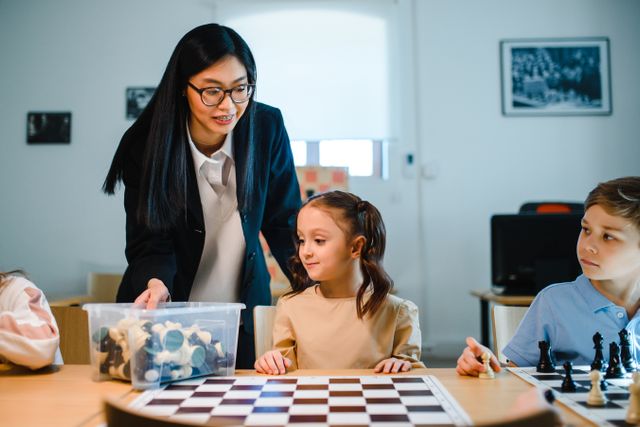
Educational games are generally designed around clearly defined objectives. Students may be required to solve a puzzle, complete a level, collect rewards, defeat an opponent, achieve a particular score, or finish a challenge within a specified time. These familiar structures make games understandable and encourage learners to continue participating. However, they also introduce an important limitation: students often concentrate on discovering the fastest way to win rather than understanding the broader system in which the game operates.
What would happen if an educational game did not provide a predefined winning strategy? Instead of receiving a fixed mission, students would enter an environment containing resources, interconnected systems, changing conditions, and different possible outcomes. They would have to observe the environment, identify opportunities, decide what they wanted to achieve, and develop their own objectives. One student might prioritise efficiency, another might focus on sustainability, while a third might investigate how to make the system more resilient. All could make meaningful progress without following the same path or competing for a single winning position.
This approach would introduce a different philosophy of game-based learning. Rather than treating success as the completion of an externally assigned task, educational games could encourage students to discover what is worth achieving within a complex environment. Learners would develop curiosity, independent thinking, strategic planning, experimentation, and the ability to recognise problems that have not already been defined for them.
For EasyShiksha, this concept offers an opportunity to connect educational games with online courses, quizzes, worksheets, practical projects, and internships. Students could move beyond answering questions with predetermined solutions and begin exploring situations in which they must identify objectives, justify decisions, and demonstrate the value of their own strategies. Such experiences could help prepare learners for professional environments where employees are frequently expected to recognise opportunities and take initiative without receiving detailed instructions for every task.
Understanding the Idea of an Educational Game Without a Winning Strategy
A conventional educational game usually begins with an explicit objective. The player knows what must be completed and often receives instructions explaining how progress will be measured. A mathematics game may require learners to reach a target score, a programming game may ask them to repair a particular application, and a business simulation may reward students for maximising profit. These approaches can be effective when the learning outcome is clearly defined and measurable.
However, a game without a predetermined winning strategy would operate differently. It would provide an environment rather than a fixed mission. Students would receive information about the available resources, system rules, constraints, and possible interactions, but they would not be told which outcome they should pursue. The learning challenge would begin with discovering what the environment makes possible and deciding what constitutes meaningful progress.
For example, students could enter a simulated city containing transportation networks, energy infrastructure, educational institutions, public services, businesses, and residential areas. The game would not instruct them to maximise economic growth or reduce pollution. Instead, students would explore the city, identify its challenges, and establish their own objectives. One learner might investigate how to improve public transportation, while another might focus on reducing energy consumption or increasing access to educational facilities.
The game would still have rules, consequences, and measurable conditions. The absence of a fixed winning strategy would not mean that anything could happen without structure. Instead, it would mean that the game allows several legitimate objectives and does not automatically rank one as universally superior. Students would be responsible for explaining why their chosen objective matters and how their actions contribute towards it.
Why Traditional Winning Strategies Can Limit Learning
A predefined winning strategy can make educational games easier to understand, but it may also encourage learners to approach complex problems too narrowly. When students know that a game rewards the highest score, shortest completion time, or largest financial return, they naturally concentrate on the activities that improve that metric. They may ignore other consequences that are not directly rewarded.
Consider a business simulation in which students must manage a manufacturing company. If the game rewards only profitability, learners may reduce production costs, increase output, and prioritise high-revenue products. These decisions might improve the final score, but they could also increase employee workload, generate more waste, reduce product quality, or create long-term operational risks. If these consequences are not included in the scoring system, students may never consider them.
A similar problem can occur in environmental games. If the objective is simply to reduce carbon emissions, learners might select strategies that improve the emissions score without examining affordability, resource availability, or effects on local communities. The game may unintentionally teach students that a single measurable outcome represents the entire problem.
Games without predetermined winning strategies could address this limitation by allowing students to define what success means within the conditions of the simulation. They would have to consider multiple outcomes rather than follow a scoring mechanism that has already decided which result matters most.
This does not mean that traditional educational games should disappear. Fixed objectives remain useful for teaching foundational knowledge, practising specific skills, and assessing clearly defined learning outcomes. However, open-ended games could provide an additional learning environment for developing judgement, exploration, and independent problem identification.
The Difference Between Having No Objective and Discovering an Objective
An educational game without a fixed winning strategy should not be confused with a game that has no purpose. A completely unstructured environment may leave students confused because they do not know what they can do, what information matters, or how to evaluate their progress. The educational value comes from giving learners enough structure to explore while leaving important decisions open.
The game could begin with an unfamiliar environment containing resources, challenges, relationships, and changing conditions. Students would be able to interact with different elements, collect information, conduct experiments, and observe consequences. As they explore, they would identify patterns or problems that interest them. Their observations would gradually develop into an objective that can be investigated through action.
For example, an educational game about managing a digital ecosystem might contain users, applications, servers, databases, security controls, and limited technical resources. Students could initially explore how the system operates without receiving a specific assignment. One student might notice that certain services experience repeated interruptions. Another might discover that data storage is becoming expensive. A third might identify security weaknesses caused by outdated dependencies.
Each learner could establish a different objective based on these observations. The game would then provide tools for testing possible solutions and examining their consequences. The objective would emerge through exploration rather than being assigned before the learning experience begins.
This process is particularly valuable because real-world problems are not always presented as clearly defined tasks. Professionals often have to recognise that something needs improvement before they can determine how to improve it.
How an Open-Objective Educational Game Could Work
An open-objective game would begin with a simulated environment that contains multiple interacting systems. The environment could represent a business, a city, a software application, a scientific ecosystem, a financial market, or an industrial process. Students would receive an introduction to the basic rules and available resources, but the game would avoid prescribing a single desired outcome.
The first stage would involve exploration. Learners could inspect different components, examine information, interact with simulated participants, and observe how one decision affects another. They might discover that a particular system is inefficient, that a resource is being used unnecessarily, or that an unexpected opportunity exists.
Once they have gathered sufficient information, students would formulate an objective. The game could ask them to explain what they want to achieve, why the objective is relevant, and which conditions will indicate progress. This step would encourage learners to convert observations into a clear and testable purpose.
The next stage would involve experimentation. Students could select actions, allocate resources, modify system settings, introduce new processes, or collaborate with other participants. The game would respond through changing conditions and measurable consequences. Some decisions might produce immediate improvements but create future problems, while others might require patience before their benefits become visible.
At regular intervals, learners could review whether their objectives remain appropriate. New information might reveal that their original goal is unrealistic or that another problem deserves greater attention. Students could then revise their objectives and explain the reasoning behind the change.
The final stage would involve reflection and evidence. Instead of simply receiving a winning score, learners would present what they discovered, which objective they pursued, how they approached the challenge, and what their results demonstrate. This would make the learning process more meaningful than a simple comparison of final scores.
Students as Objective Designers Rather Than Task Followers
One of the most important changes introduced by this model is the role of the student. In conventional games, learners primarily respond to tasks created by the game designer. In open-objective games, they become active designers of their own learning challenges.
This shift requires students to develop several connected abilities. They must observe a situation, identify a meaningful issue, determine whether it can be investigated, and establish a realistic objective. They must also decide which information is necessary and how progress should be evaluated.
For example, students exploring a simulated university environment might notice that many learners are unable to access certain digital learning resources. One student could decide to investigate whether the problem is related to internet connectivity. Another might examine whether the resources are difficult to discover or navigate. A third could explore whether the learning materials are unsuitable for particular devices.
All three students would be investigating the same environment, but their objectives would be different. Their work could still be assessed because each objective would require a clear explanation, relevant evidence, and an evaluation of the outcome.
This approach would encourage students to take responsibility for identifying the purpose of their work. It would also reduce the tendency to wait for detailed instructions before beginning an unfamiliar task.
Exploring Multiple Objectives Within the Same Environment
A major advantage of open-objective educational games is that the same simulation can support different learning pathways. Instead of creating a separate game for every possible outcome, developers could design one environment containing several interconnected opportunities for investigation.
A simulated hospital management environment, for example, could support objectives related to patient waiting times, resource allocation, digital record accuracy, energy consumption, staff scheduling, and service accessibility. Students studying healthcare administration might investigate operational efficiency, while learners interested in information technology could examine the reliability of digital systems.
These objectives would not necessarily be independent. Improving one part of the system might affect another. Reducing waiting times could increase staff pressure, while improving data collection could require additional infrastructure. Students would therefore have to examine how their decisions influence the wider environment.
This structure could make educational games more suitable for interdisciplinary learning. Students from different academic backgrounds could explore the same scenario while focusing on different professional questions. They would also gain opportunities to understand why complex problems rarely belong to a single subject.
Learning Through Uncertainty and Unpredictable Consequences
Traditional educational games often provide relatively predictable feedback. Students complete an activity, receive a score, and understand whether their performance was successful. Open-objective games could introduce more complex feedback systems in which the consequences of decisions depend on changing conditions.
For example, students managing a simulated agricultural environment might initially decide to increase crop production. Their strategy could improve short-term output, but changing weather conditions, water availability, soil quality, and market demand might affect the long-term results. A decision that appears successful in one period could become unsuitable later.
This would encourage learners to think beyond immediate rewards. They would need to consider uncertainty, evaluate possible risks, and recognise that even well-planned decisions may produce unexpected outcomes.
The game could also introduce incomplete information. Students might not know the exact condition of every resource or the future behaviour of every system component. They would have to decide whether to collect more information, run an experiment, or act using the evidence currently available.
Such experiences could develop a more realistic understanding of decision-making. In professional environments, uncertainty is not always a temporary obstacle that disappears after enough research. Sometimes it remains an important condition that must be managed throughout a project.
Open-Objective Games Across Different Academic Disciplines
Computer Science and Software Development
Computer science students could explore a simulated software ecosystem containing applications, databases, programming interfaces, dependencies, users, and infrastructure. The game would not instruct them to build a particular feature or repair a predefined error. Instead, learners could investigate the environment and identify technical improvements.
One student might decide to improve application performance, while another could examine system security or software maintainability. A third learner might investigate whether the architecture can support an increase in users. Each objective would require different technical knowledge and experimentation.
Students could modify code, inspect system logs, test alternative configurations, and observe the results. The simulation could introduce unexpected dependency failures or changes in user demand, requiring learners to reconsider their strategies.
This would help students understand that software development involves more than implementing assigned features. Developers must also identify weaknesses, evaluate future requirements, and recognise opportunities for improving existing systems.
Business and Management
Business students could enter a simulated organisation containing departments, employees, customers, financial information, supply chains, and operational processes. Instead of receiving a fixed objective such as maximising revenue, they would explore the organisation and identify a problem or opportunity.
One learner might investigate customer retention, while another could focus on reducing operational waste. A third might examine employee training or the organisation’s dependence on a limited number of suppliers.
The game could show how these objectives interact. Reducing costs might affect product quality, while expanding customer support could increase operating expenses. Students would need to explain why their chosen objective is important and how they would measure its wider impact.
This experience could develop strategic thinking and help learners understand that business performance cannot always be represented through one financial metric.
Environmental Science and Sustainability
Environmental science offers particularly strong opportunities for open-objective games because ecological systems contain many interconnected variables. Students could explore a simulated region containing forests, rivers, agricultural areas, urban settlements, wildlife habitats, and energy infrastructure.
They might decide to investigate water conservation, biodiversity, pollution reduction, renewable energy, or sustainable land use. Their decisions would influence other parts of the environment, making it necessary to consider long-term consequences.
A learner who focuses on expanding renewable energy might discover that land availability and infrastructure costs create additional challenges. Another who investigates forest conservation might need to examine how local employment and agricultural activity affect the feasibility of proposed interventions.
Such a game could encourage students to understand sustainability as a system-wide challenge rather than a single environmental target.
Finance and Economics
Finance students could explore a simulated economy containing businesses, consumers, financial institutions, investment opportunities, and market conditions. The game would not automatically reward the highest possible return. Instead, students could establish objectives related to financial stability, risk reduction, responsible investment, or long-term growth.
One student might investigate how a business can improve its cash flow without increasing financial risk. Another could examine how changing interest rates influence investment decisions. A third might focus on the financial accessibility of services for different customer groups.
The simulation could introduce economic changes and unexpected market conditions. Students would have to examine how their decisions influence multiple stakeholders and whether their original objectives remain appropriate.
Cybersecurity and Digital Safety
Cybersecurity students could investigate a simulated digital organisation containing user accounts, networks, applications, access controls, and security monitoring systems. The game would not simply instruct learners to find a hidden vulnerability. Instead, students could discover their own security objectives.
One learner might focus on reducing unauthorised access, another could investigate incident response readiness, and a third might examine the organisation’s dependency on outdated software. Each objective would involve different evidence and technical actions.
The simulation could introduce new threats or reveal previously unknown weaknesses. Students would need to reconsider their priorities and understand that improving one security control does not automatically eliminate every risk.
Could Students Collaborate Without Sharing the Same Objective?
Open-objective games could also introduce a new form of multiplayer learning. Instead of requiring all participants to work towards one shared winning condition, the game could allow students to pursue different objectives within the same environment.
For example, a group of students might manage a simulated smart city. One learner could focus on public transportation, another on energy efficiency, and another on digital infrastructure. Their objectives would be different, but their decisions would affect the same city.
This creates opportunities for collaboration because students would need to understand how their individual projects influence other participants. Improving transportation might change energy consumption, while modifying digital infrastructure could affect the information available to other departments.
The game could require learners to negotiate shared resources, exchange evidence, and coordinate decisions. They would learn that collaboration does not always mean having identical goals. In professional organisations, departments often work towards different objectives while remaining responsible for the success of the wider organisation.
Such experiences could help students develop communication, negotiation, and systems-thinking abilities. They would also understand why a successful team needs to coordinate different forms of expertise rather than force every participant to follow the same strategy.
How Educational Games Could Measure Progress Without a Traditional Winning Score
Removing a fixed winning strategy raises an important assessment question. If students are pursuing different objectives, how can the game determine whether they have learned something meaningful?
The solution would be to assess the quality of the learning process rather than compare every student against one universal score. Each learner could be evaluated on how effectively they identify a problem, justify an objective, collect relevant information, develop a strategy, and interpret the consequences of their actions.
For example, a student who chooses to reduce energy consumption in a simulated building could be assessed on whether the objective is clearly defined, whether the selected measurements are relevant, and whether the proposed changes produce the intended results. Another student investigating accessibility could be evaluated using a different set of indicators appropriate to that objective.
This does not prevent measurable assessment. The game could still record resource usage, decision history, experiments, progress indicators, and final outcomes. However, these measurements would provide evidence about each student’s work rather than determine a single universal winner.
Students could also submit a reflection explaining what they initially expected, what they discovered, which decisions were unsuccessful, and how their objective changed during the experience. This would make the assessment more informative because it would reveal the reasoning behind the final result.
The Importance of Reflection and Learning From Unsuccessful Objectives
An open-objective game should treat unsuccessful experiments as valuable learning experiences. Students may choose objectives that are too broad, unrealistic, difficult to measure, or poorly suited to the available resources. These situations can reveal important lessons about planning and problem identification.
For instance, a student might decide to eliminate all traffic congestion in a simulated city. After exploring the available infrastructure and testing different policies, the learner may discover that the objective is too broad to achieve within the game’s constraints. The student might then revise the goal to reduce congestion around a particular transport corridor during peak hours.
This adjustment would demonstrate an important professional skill: the ability to refine an objective when the original goal is not sufficiently practical.
Reflection could also help students recognise when a strategy produced unintended consequences. A learner who improves production efficiency might discover that the selected process increases waste or creates maintenance problems. Instead of treating the result as a simple failure, the student could investigate why the outcome differed from expectations.
EasyShiksha could support this process through reflection worksheets and project reports. Students would document their original assumptions, experiments, decisions, and revised objectives. This would help them understand that learning often involves changing direction when new evidence becomes available.
The Role of AI in Open-Objective Educational Games
Artificial intelligence could make open-objective games more responsive by helping students explore complex environments and discover potential areas of investigation. An AI-supported system could analyse the learner’s interactions and provide questions that encourage further exploration without directly assigning a mission.
For example, if a student repeatedly examines the energy consumption of a simulated manufacturing facility, the system could ask whether the learner has considered differences between production periods or the relationship between equipment maintenance and energy efficiency. These questions could help students identify possible objectives while preserving their responsibility for making the final decision.
AI could also generate alternative scenarios based on the learner’s interests and academic background. A student studying data science might receive opportunities to investigate information quality or prediction accuracy, while a business student could explore operational performance or customer behaviour.
Another potential use would be adaptive feedback. If a learner establishes an objective that cannot be measured, the system could explain why the evaluation criteria are insufficient and encourage the student to develop clearer indicators. It could also help identify contradictions between a student’s stated objective and their actual decisions.
However, AI should not become an invisible source of predetermined winning strategies. If the system continually tells students what to investigate and which action to take, the educational experience may become another conventional task-based game. AI should act as a facilitator that supports exploration, not as an authority that replaces student initiative. Human educators should also review important learning outcomes and ensure that generated scenarios remain technically and educationally appropriate.
Connecting Open-Objective Games With Online Courses and Quizzes
Open-objective games could become more effective when connected to structured online courses. Students need foundational knowledge to understand the systems they are exploring. A learner studying cybersecurity, for example, should understand basic network security principles before attempting to investigate vulnerabilities in a simulated organisation.
EasyShiksha could introduce a learning pathway in which an online course provides the required concepts, followed by an open-objective game that allows students to apply them in an unfamiliar environment. This would help learners move from understanding established knowledge to identifying situations in which that knowledge may be useful.
Quizzes could assess foundational understanding before students enter the game. During the simulation, short knowledge checks could help learners evaluate their understanding of particular concepts without forcing them towards one final objective. Worksheets could support deeper analysis by asking students to document observations, define objectives, and interpret results.
The connection would create a more comprehensive learning experience. Courses would provide subject knowledge, quizzes would reinforce important concepts, games would encourage exploration, and worksheets would help students communicate their reasoning. Practical projects and internships could then extend the same learning approach into more realistic professional situations.
From Open-Objective Games to Practical Projects and Internships
The ability to discover objectives is particularly valuable in professional environments because employees do not always receive detailed instructions. Organisations may ask an intern to examine a process, review an existing system, or identify areas for improvement without specifying every action required.
An open-objective game could prepare students for this responsibility by allowing them to practise problem discovery in a controlled environment. A student who has learned to explore a simulated business, identify an operational issue, and propose an investigation would have a stronger foundation for approaching similar responsibilities during an internship.
For example, a student completing a digital marketing course might enter a simulation containing website traffic, search visibility, customer behaviour, and campaign performance information. The game would not instruct the learner to increase website traffic. The student might instead discover that traffic is already increasing but conversion rates remain low. This could lead to an investigation of landing page design, audience relevance, or the registration process.
During an actual internship, the student could apply similar reasoning while working with approved company information and under supervisor guidance. Rather than waiting for a narrowly defined task, the intern could identify an opportunity for investigation and present a reasoned proposal.
For EasyShiksha, this creates a natural connection between educational games and internship programmes. Games could develop initiative and independent thinking, while internships could provide supervised opportunities to apply these abilities to genuine workplace challenges.
Designing Fair and Accessible Open-Objective Games
Although open-objective games offer considerable educational potential, their design must account for differences in student experience, academic preparation, and confidence. Some learners may quickly identify possible objectives, while others may struggle because they are unfamiliar with the subject or uncertain about what the environment allows them to do.
A useful approach would be to provide structured exploration without revealing the final objective. The game could introduce basic tutorials, explain the available controls, and provide examples of how different systems interact. Students would understand how to investigate the environment without being told which problem they must solve.
Accessibility is equally important. Students should be able to explore the simulation through interfaces suited to different devices and learning requirements. Clear navigation, readable information, appropriate language, and alternative ways of interacting with the environment could help more learners participate.
Assessment should also avoid rewarding only ambitious objectives. A student who identifies a small but meaningful issue and investigates it thoroughly may demonstrate stronger learning than someone who chooses an extremely broad objective without developing a workable strategy. The quality of reasoning, evidence, and reflection should remain more important than the apparent size of the chosen goal.
Educators should also provide clear boundaries around the simulation. Students need to know which actions are permitted, which resources are limited, and which safety or ethical requirements cannot be ignored. Freedom to define objectives should not mean freedom to disregard responsible conduct.
Challenges in Developing Games Without a Fixed Winning Strategy
The first major challenge is designing an environment that offers meaningful opportunities without overwhelming learners. If the simulation contains too few possibilities, students may quickly exhaust its educational value. If it contains too many interconnected systems, beginners may find it difficult to identify where to start.
Another challenge involves assessment consistency. When students pursue different objectives, educators need reliable ways to evaluate their work without imposing the same outcome on everyone. This requires assessment frameworks that focus on transferable capabilities such as objective definition, evidence evaluation, experimentation, reasoning, and reflection.
There is also a risk that some students may choose objectives that are too easy. A learner might select a simple activity that produces an immediate result but offers little opportunity for deeper learning. The game could address this by asking students to justify the significance and complexity of their objectives. Educators could also provide feedback when an objective does not sufficiently challenge the learner.
A further challenge concerns the difference between freedom and confusion. Students should be able to discover their own direction, but they should not be abandoned without support. Contextual hints, optional guidance, progress reflections, and instructor feedback could help learners move forward without removing their responsibility for decision-making.
Finally, developers must ensure that the simulation does not reward harmful or unethical behaviour simply because it produces a measurable improvement. An objective that increases productivity by exploiting workers or compromises user privacy should not be treated as an acceptable outcome. Ethical and safety constraints must remain part of the game’s underlying design.
The Future of Educational Games as Environments for Independent Thinking
Educational games could gradually evolve from systems that reward task completion into environments that help students discover problems, establish objectives, and evaluate the consequences of their own decisions. This would represent a meaningful change in the purpose of game-based learning.
Instead of asking whether a student can follow the correct strategy, educators could examine whether the learner can recognise what needs to be investigated. Instead of rewarding only a final score, they could evaluate how students develop their objectives, respond to uncertainty, and explain the outcomes of their experiments.
This model is particularly relevant as professional roles increasingly involve interdisciplinary responsibilities, rapidly changing technologies, and complex decision-making. Employees may need to identify problems that were not included in their original job descriptions, recognise emerging opportunities, and determine which actions could create long-term value.
Students who practise these abilities through open-objective educational games may become more comfortable with unfamiliar situations. They could learn that a lack of predefined instructions does not necessarily indicate the absence of direction. It may be an opportunity to observe, investigate, and create a meaningful purpose.
For EasyShiksha, the concept could support a more advanced approach to digital learning in which courses, quizzes, worksheets, educational games, projects, and internships contribute to the development of independent problem-solving capabilities. Learners would not simply complete educational activities. They would demonstrate how they identify challenges and create their own pathways towards meaningful outcomes.
Conclusion
What if educational games stopped telling students exactly what they needed to achieve? Instead of competing for a fixed score or following a predetermined winning strategy, learners could enter interactive environments, explore their possibilities, and discover their own objectives. This approach would encourage curiosity, independent thinking, experimentation, and the ability to recognise problems that have not already been defined.
Games without fixed winning strategies would not remove structure or assessment. They would replace universal winning conditions with meaningful objectives that students must define, justify, and evaluate. Their progress could be measured through the quality of their decisions, the relevance of their evidence, the effectiveness of their experiments, and their ability to learn from unexpected outcomes.
The approach could be applied across computer science, business, finance, environmental science, cybersecurity, engineering, and other disciplines. Multiplayer environments could further develop collaboration by allowing students to pursue different but interconnected objectives. AI could support exploration and reflection, while online courses, quizzes, worksheets, projects, and internships could provide the knowledge and practical experiences needed to extend learning beyond the game.
For EasyShiksha, this concept represents an opportunity to make educational games more than interactive exercises. They could become environments in which students learn to identify opportunities, define meaningful goals, and take responsibility for their decisions. Ultimately, preparing students for the future requires more than teaching them how to complete assigned tasks. It also requires teaching them how to recognise what is worth doing when nobody has already provided the answer.