

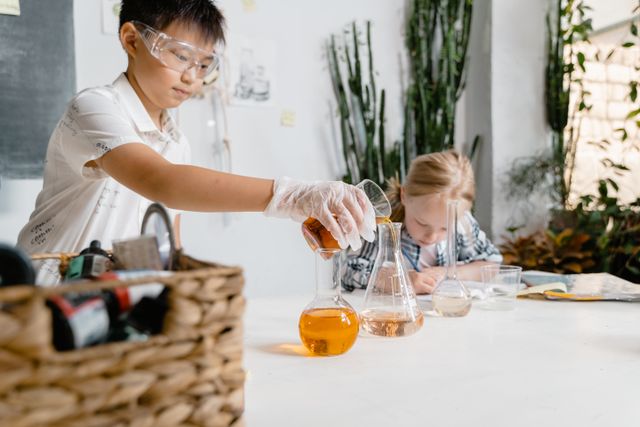
Education has traditionally depended on experiments, observations, demonstrations, and practical activities to help students understand how the world works. A chemistry student observes a reaction in a laboratory, a physics student measures the motion of an object, and a business student analyses the outcome of a marketing decision. These experiences connect theoretical knowledge with observable results and help learners develop the ability to interpret evidence.
However, real-world experiments have limitations. They may require expensive equipment, specialised facilities, substantial time, or materials that are difficult to access. Some experiments are too dangerous to perform in an ordinary educational environment, while others involve conditions that cannot be reproduced reliably. There are also experiments that would be valuable to study but have never occurred because the necessary circumstances have not arisen or the resources required to investigate them are unavailable.
What if students could learn from experiments that have never happened?
Imagine a physics student exploring how a material might behave under unfamiliar environmental conditions, a business student testing the consequences of a market strategy that no company has implemented, or an environmental science student examining a hypothetical ecosystem affected by several interacting variables. Instead of waiting for a real-world event, students could investigate carefully constructed experimental scenarios, change the conditions, observe predicted outcomes, and evaluate the reasoning behind those outcomes.
This possibility introduces the concept of Counterfactual Experiment Learning, an educational approach in which students investigate hypothetical situations, simulated conditions, and alternative outcomes that have not necessarily occurred in reality. Artificial intelligence, computational models, digital simulations, and scientific reasoning could help construct these experiences while allowing students to explore questions that conventional classrooms cannot easily address.
For EasyShiksha, this concept could create new connections between online courses, quizzes, educational games, practical projects, certificates, and career development. Instead of learning only from established examples, students could investigate alternative possibilities, test hypotheses, examine unexpected results, and develop evidence-based reasoning. The objective would not be to replace real experiments with imaginary ones. It would be to expand the range of questions students can explore while teaching them to distinguish scientifically grounded predictions from speculation.
What Is Counterfactual Experiment Learning?
Counterfactual Experiment Learning is a proposed educational model in which learners investigate what might happen under conditions that differ from an observed or established situation. The term counterfactual refers to considering an alternative scenario: what would happen if a particular variable changed, a different decision were made, or an event unfolded under different conditions?
In ordinary experimental learning, students often begin with an established procedure and observe the result. Counterfactual learning expands this process by allowing students to examine alternative conditions and compare their predicted outcomes. The learner becomes an investigator of possibilities rather than simply a recipient of predetermined demonstrations.
Consider a student studying plant growth. A conventional experiment might compare plants receiving different amounts of water under controlled conditions. A counterfactual learning environment could extend the investigation by allowing students to explore hypothetical combinations of temperature, soil composition, light exposure, and watering patterns. The student could examine how changing several variables might influence the result and identify which predictions require additional evidence.
Such a system would need a suitable model of plant growth and a clear explanation of its assumptions. It could not reliably predict every possible biological interaction simply because the simulation permits students to change a parameter. The educational value lies in using the model to explore relationships, formulate hypotheses, and understand uncertainty.
The same principle applies across subjects. Students could investigate alternative engineering designs, hypothetical economic policies, different software architectures, or environmental conditions that have not been observed together. Each scenario would provide an opportunity to practise reasoning about cause and effect.
For EasyShiksha, counterfactual experiment learning could become a framework for creating interactive educational experiences in which students do more than memorise established results. They would learn to ask questions, design investigations, interpret outcomes, and recognise the limits of their conclusions.
Why Education Needs Experiments That Have Never Happened
Traditional experiments are valuable because they connect theory with evidence. Yet the range of experiments students can perform is often limited by time, equipment, cost, safety, and the availability of suitable conditions. A classroom may teach a concept without providing an opportunity to investigate its full range of possible applications.
A learner studying renewable energy, for example, might understand how solar panels generate electricity but have limited opportunities to explore how different combinations of shading, panel orientation, temperature, and energy storage affect a complete system. A simulation could allow the learner to investigate these interactions without requiring access to a full-scale installation.
Similarly, a student studying business management may analyse historical decisions but struggle to explore alternative strategies in a controlled environment. A simulated company could allow the student to change pricing, inventory, advertising, and resource allocation while examining how the model responds.
Counterfactual experiments can also make rare or extreme conditions available for educational investigation. Students may explore hypothetical engineering failures, unusual weather scenarios, or alternative disease-spread conditions through carefully designed models. These scenarios can help learners understand why certain variables matter and why a decision that works in one context may fail in another.
The purpose is not to imply that every hypothetical scenario is equally plausible. Instead, students gain access to a broader range of questions while learning to evaluate whether the assumptions behind each scenario are reasonable.
For EasyShiksha, this approach could extend practical learning beyond the limitations of physical laboratories and traditional case studies. It could help learners investigate more possibilities, especially when real-world experimentation is expensive, impractical, or unsafe.
The Architecture of an Experiment That Has Never Happened
A meaningful counterfactual experiment requires more than a prompt asking artificial intelligence to imagine a result. It needs a structured environment in which the question, assumptions, variables, model, and interpretation are clearly defined.
The process begins with an experimental question. A student might ask what would happen if an urban area replaced a portion of its conventional electricity supply with renewable energy, or how a software system might behave if the number of simultaneous users increased significantly. The question establishes the relationship the learner wants to investigate.
The next stage identifies the variables and assumptions. In an energy scenario, these might include electricity demand, generation capacity, weather conditions, storage, and transmission constraints. In a software scenario, they could include traffic volume, server capacity, network latency, and database performance.
The system then selects an appropriate model. Depending on the subject, this might be a mathematical equation, a physics simulation, a statistical model, an economic framework, or a simplified interactive representation. The model determines which relationships can be explored and which conditions it cannot represent reliably.
Students can then modify the variables, observe the model’s outputs, and compare alternative scenarios. The final stage involves interpreting the results, explaining the assumptions, and identifying what additional evidence would be required to establish whether the prediction is realistic.
This architecture makes the experiment educationally meaningful because the learner is not merely watching a generated scenario. They are participating in an investigation with explicit assumptions and a traceable reasoning process.
For EasyShiksha, such a framework could support interactive learning activities in which each experiment connects a course concept with an investigation, a result, and a reflection on what the result means.
AI-Generated Experiments and the Importance of Scientific Grounding
Artificial intelligence could make counterfactual experiments easier to create by helping generate scenarios, explain variables, propose alternative conditions, and adapt investigations to different learning levels. However, AI-generated scenarios introduce a significant risk: a convincing explanation can sound scientifically credible even when the underlying prediction is unsupported.
An educational system must therefore distinguish between generating an experimental question and establishing a reliable answer. AI may suggest an interesting hypothetical situation, but the resulting predictions should be grounded in an appropriate model, established evidence, or clearly stated assumptions.
For example, an AI assistant might propose investigating how a new building material would behave under extreme heat. If the system lacks reliable information about the material’s properties, it should not invent precise measurements and present them as scientific results. It could instead help the learner identify the missing data, construct a simplified theoretical model, and understand which conclusions remain uncertain.
This distinction is central to responsible counterfactual learning. A hypothetical experiment can be educationally useful even when its outcome is unknown, provided students understand the difference between a model-based prediction and an established observation.
A well-designed platform should identify whether a result comes from a mathematical calculation, a validated simulation, an empirical dataset, or an illustrative assumption. These categories provide different levels of support and should not be presented as equivalent.
EasyShiksha could use AI to help educators create and adapt experimental scenarios while requiring suitable validation for the subject and learning objective. In this model, AI would expand the range of questions students can explore without becoming an unquestioned source of experimental truth.
Exploring Alternative Scientific Outcomes
One of the most valuable applications of counterfactual experiment learning is the ability to compare alternative scientific outcomes. Students often learn established laws and accepted explanations, but understanding becomes deeper when they investigate how outcomes change as conditions change.
In physics, a learner might explore how the motion of an object changes when friction, mass, or applied force is modified. A simulation could help the student identify relationships between variables and test whether an initial prediction matches the model’s output.
In chemistry, students could investigate reaction conditions through simulations designed around appropriate chemical principles. They might explore how temperature, concentration, or catalysts influence a reaction, while learning that the actual relationship depends on the particular chemical system and the assumptions of the model.
Environmental science offers another opportunity. Students could examine hypothetical combinations of rainfall, land use, vegetation, and water consumption to understand how different factors may influence a watershed. They could compare alternative scenarios and determine which assumptions strongly affect the predicted outcome.
The educational value comes from the investigation rather than the novelty of the scenario alone. Students must formulate a prediction, manipulate variables systematically, interpret the result, and explain the reasoning behind their conclusions.
For EasyShiksha, these experiments could complement science courses and quizzes by providing opportunities to apply theoretical concepts in interactive environments. Students could test their understanding through investigation rather than relying exclusively on memorisation or standard examination questions.
Counterfactual Experiments in Engineering and Technology
Engineering involves designing systems that must operate under real constraints. Students need to understand not only how a design works under normal conditions but also how it might behave when assumptions change or unexpected problems occur.
Counterfactual simulations could help learners explore these situations before building a physical prototype. An engineering student might compare alternative bridge designs under different load assumptions, examine how a manufacturing process responds to a change in temperature, or investigate the consequences of reducing the capacity of a component.
These investigations could expose students to trade-offs that are difficult to demonstrate through a single practical exercise. Increasing strength might increase cost, improving efficiency might introduce complexity, and reducing material use might affect durability. The student would need to compare alternatives rather than search for one universally optimal solution.
Software engineering provides a particularly accessible application. A student could investigate what might happen if an application received ten times its expected traffic, if a database connection failed, or if a third-party service became unavailable. The simulation could help the learner reason about scalability, fault tolerance, and system design.
However, model limitations remain important. A simplified simulation cannot establish that a real bridge, industrial process, or production software system is safe. High-stakes engineering decisions require appropriate calculations, testing, professional standards, and expert review.
Within EasyShiksha, counterfactual engineering exercises could help students develop a habit of testing assumptions before implementation. They could connect theoretical courses with project work and encourage learners to consider not only how a design functions, but also how it might fail.
Business Strategy: Testing Decisions Before They Exist
Business education frequently uses historical case studies to examine successful companies, market failures, and strategic decisions. These cases are valuable, but they primarily describe events that have already occurred. Counterfactual experiments could allow students to investigate alternative decisions within a structured business model.
Imagine a learner studying digital marketing who is given a simulated campaign with a fixed budget. The student can change the audience, advertising channels, campaign duration, and creative approach. The model then estimates how those choices might influence reach, conversions, and cost under its stated assumptions.
The learner could compare several strategies and explain why one approach appears more suitable for a particular objective. They might discover that increasing advertising expenditure does not necessarily improve profitability or that a campaign producing more clicks may generate fewer valuable conversions.
A business simulation could also explore inventory decisions, pricing strategies, hiring choices, or customer retention. Students could see how decisions interact over time and how a strategy that initially appears successful may create problems later.
The results must be presented as scenario outputs rather than guaranteed predictions of real market behaviour. Consumer preferences, competitor responses, economic conditions, and unexpected events may differ from the assumptions embedded in the model.
For EasyShiksha, business simulations could connect management and marketing courses with practical decision-making exercises. Students would gain experience comparing alternatives, interpreting results, and explaining the reasoning behind a strategy before applying similar thinking to real projects or internships.
Learning From Failures That Have Never Occurred
Failure is an important source of learning, but real-world failures can be costly, dangerous, or difficult to reproduce. Counterfactual experiments provide a way to investigate plausible failure scenarios without requiring students to experience every consequence directly.
A cybersecurity learner could explore a simulated system in which weak authentication, excessive permissions, or inadequate monitoring creates vulnerabilities. The student could modify the system’s controls and investigate how different choices influence the modelled risk.
A software development student might examine a hypothetical application failure caused by increased traffic, incorrect data handling, or a dependency becoming unavailable. By comparing alternative responses, the learner could understand the importance of testing, monitoring, and resilient design.
Business students could examine the consequences of excessive inventory, poor cash-flow planning, or an ineffective pricing decision. Environmental science students might investigate how several land-use decisions could combine to increase a modelled flood risk.
These activities can develop a more systematic approach to failure. Instead of treating an unsuccessful outcome as a single event, students learn to examine contributing factors, identify assumptions, and evaluate preventive measures.
Nevertheless, a simulated failure should not be confused with direct experience of a real incident. A model may omit important factors, and some consequences are difficult to reproduce accurately. Students should understand the scope of the simulation and the limitations of the conclusions it supports.
For EasyShiksha, failure-based experiments could become a valuable component of games, projects, and career-oriented learning. They would allow learners to practise diagnosing problems and making decisions while keeping the exercise within a controlled educational environment.
From Passive Lessons to Student-Led Investigation
Traditional digital learning often follows a predictable sequence: the student watches a lesson, reads an explanation, completes a quiz, and receives a score. This structure can communicate information efficiently, but it may provide limited opportunities for learners to formulate their own questions.
Counterfactual experiment learning changes the student’s role. Instead of only answering questions selected by the instructor, learners can investigate a question, decide which variables to change, and compare alternative explanations.
For example, a student studying web performance might begin with a simulated website that loads slowly under certain conditions. The learner could investigate whether image sizes, network latency, server capacity, or inefficient scripts are responsible for the slowdown. Different experiments could produce different results, encouraging the student to examine evidence before reaching a conclusion.
The educator’s role also changes. Rather than simply delivering information, the instructor becomes a designer of investigative environments and a guide who helps learners interpret results. The educator can challenge unsupported conclusions, ask students to explain their assumptions, and encourage comparisons between different approaches.
This does not mean every lesson must become an open-ended simulation. Direct instruction remains useful when students need foundational knowledge or when a concept is difficult to discover independently. Counterfactual experiments work best when they complement explanations and provide opportunities to apply them.
EasyShiksha could integrate these investigations into existing courses by introducing short experimental activities at relevant points in the learning journey. The goal would be to make learners active participants in constructing and evaluating explanations.
Connecting Experiments With Quizzes, Projects, and Certificates
Counterfactual experiments become more valuable when they are connected to the rest of the learning journey. A simulation on its own may generate engagement, but students also need ways to demonstrate what they learned and apply it beyond the experimental environment.
A course could begin with an explanation of the relevant concepts, followed by a quiz that assesses foundational understanding. Students could then enter a simulation and investigate alternative scenarios. After completing the experiment, they might submit a written explanation, answer questions about the results, or complete a project applying the same principles to a new problem.
This sequence creates several forms of evidence. The quiz can show whether the student understands key concepts, while the simulation reveals how the learner investigates a problem. The written explanation can demonstrate reasoning, and the project can show whether the student can apply the learning in a different context.
Certificates could recognise completion of the learning programme or a clearly defined competency assessment, provided the evidence supports that claim. Completing a simulation alone should not automatically be interpreted as proof of advanced practical competence.
For EasyShiksha, this approach could create a connection between courses, quizzes, games, projects, and certificates. Each component would contribute to a broader educational outcome rather than operating as an isolated feature.
The Role of AI in Generating Personalised Experiments
Artificial intelligence could help adapt experimental learning to the needs of individual students. Beginners may require simplified scenarios with fewer variables, while advanced learners may be ready to investigate interactions between several factors. AI could help adjust the complexity of an experiment while preserving its core learning objective.
A student learning basic economics, for instance, might begin by examining the relationship between price and demand in a simplified model. Later, the learner could investigate how competition, consumer preferences, and production costs complicate the relationship. Each stage would introduce additional complexity after the relevant foundations had been established.
AI could also help generate alternative versions of an experiment. Two learners might investigate the same principle using different datasets, initial conditions, or case scenarios. This could encourage independent reasoning and reduce reliance on memorising a single example.
However, personalisation should not mean that every student receives a completely different scientific reality. The system must preserve the validity of the underlying model and ensure that changes in difficulty do not alter the meaning of the learning objective.
AI-generated experiments should also be reviewed for factual accuracy and suitability. In subjects involving safety, health, finance, or engineering, unsupported predictions could mislead learners if presented without sufficient qualifications.
EasyShiksha could use AI to assist educators in producing experimental variations, hints, and reflection questions. Educators would retain responsibility for verifying the model, defining the learning outcomes, and determining whether the resulting activity is educationally appropriate.
Teaching Students to Understand Uncertainty
One of the most important benefits of counterfactual experiments is the opportunity to teach uncertainty explicitly. Students often encounter educational questions with one expected answer, but real-world problems frequently involve incomplete information, competing explanations, and outcomes that cannot be predicted with certainty.
A simulation can help students understand that a result depends on the assumptions built into the model. If a business scenario assumes stable consumer demand, the outcome may change when that assumption is modified. If an environmental model excludes a particular source of pollution, its predictions may not represent the full situation.
Students should therefore learn to ask not only what a model predicts, but also why it produces that prediction and what information it leaves out. They can compare alternative assumptions, examine the sensitivity of the results, and identify where additional evidence would improve the analysis.
This is particularly important when AI generates explanations. A confident answer is not necessarily a reliable one, and a detailed simulation does not guarantee that the model captures every relevant variable.
For EasyShiksha, uncertainty-aware learning could help students develop stronger analytical habits. Rather than accepting every output as fact, learners would practise distinguishing established evidence, model-based predictions, and unresolved questions.
Assessing the Quality of Experimental Reasoning
If counterfactual experiments become part of digital education, assessment should examine more than whether students reach the expected result. Learners may arrive at a plausible conclusion through weak reasoning, or they may identify an important limitation even when their final prediction differs from the model’s expected outcome.
A stronger assessment would examine how students formulate hypotheses, select variables, interpret results, and justify conclusions. It could evaluate whether learners change one variable at a time when appropriate, recognise confounding factors, and explain the limitations of the model they used.
Students should also be able to distinguish between a prediction and an observation. If a simulation produces a particular output, the learner should understand that this output describes the model’s behaviour under its assumptions. It does not automatically establish that the same result would occur in a real-world experiment.
Assessment can combine automated checks with written explanations and educator review. Automated systems may verify calculations or compare results against a defined model, while more interpretive judgments may require human evaluation.
For EasyShiksha, this assessment approach could help transform experimental activities into meaningful learning evidence. The platform could evaluate not just whether students completed an experiment, but whether they understood what it demonstrated and what it could not establish.
Ethical Boundaries and Responsible Simulation Design
Counterfactual learning introduces ethical responsibilities because simulated scenarios can influence how students understand complex issues. A model that omits important social, economic, or environmental factors may produce misleading conclusions, particularly when students interpret its results as neutral or comprehensive.
For example, an economic simulation might simplify consumer behaviour in ways that overlook differences in income or access to resources. A public health scenario might omit important behavioural factors. An environmental model might represent one ecosystem accurately while being unsuitable for another.
The system should make these limitations visible. Students need to understand the purpose of a model, the assumptions it uses, and the circumstances in which its conclusions may not apply. Instructors should also review scenarios for inappropriate stereotypes, misleading simplifications, and potentially harmful interpretations.
Privacy is another consideration when experiments use learner data or personalised profiles. Educational simulations should collect only the information necessary for their purpose, and students should understand how their information is used.
For EasyShiksha, responsible simulation design would require a balance between experimentation, accessibility, and trust. The platform should encourage exploration without implying that a simulated outcome is equivalent to an established scientific finding.
The Future of Education: Learning From Possibilities Before Reality
The future of education may increasingly involve environments in which students can investigate more possibilities than real-world conditions would normally permit. Computational models, AI-assisted scenario generation, interactive simulations, and digital laboratories could help learners explore alternative outcomes before attempting a physical experiment or making a consequential decision.
This approach could be especially valuable in fields where mistakes are expensive, experimentation is difficult, or systems involve many interacting variables. Students could investigate alternative engineering designs, examine business strategies, explore environmental scenarios, or test software failure conditions within controlled environments.
Yet the objective should not be to replace reality with simulations. Real-world experiments remain essential for validating theories, measuring actual behaviour, and discovering effects that existing models fail to capture. Counterfactual learning is strongest when it helps students formulate better questions, understand relevant variables, and prepare for more rigorous investigation.
For EasyShiksha, the opportunity lies in connecting these experiences with structured courses, quizzes, projects, and practical learning. Students could learn a concept, explore alternative scenarios, explain the results, and apply the underlying principle to a new challenge. The learning journey would extend beyond established examples without abandoning the importance of evidence.
Conclusion: Education That Lets Students Explore the Unobserved
What if students could learn from experiments that have never happened? They could investigate alternative conditions, compare hypothetical outcomes, test assumptions, and develop a deeper understanding of how complex systems behave. They could explore questions that are too expensive, dangerous, rare, or impractical to investigate directly, while learning to distinguish model-based predictions from verified observations.
Counterfactual Experiment Learning offers a framework for making these experiences educationally meaningful. It combines clearly defined questions, explicit assumptions, suitable models, interactive investigation, and reflective assessment. Artificial intelligence could help generate and personalise scenarios, while scientific grounding and human oversight would protect the reliability of the learning experience.
For EasyShiksha, this concept could connect online courses, quizzes, educational games, projects, certificates, and career-oriented learning through a shared investigative approach. Students would not simply receive explanations about how systems work. They would have opportunities to examine how those systems might behave under different conditions, understand why the outcomes change, and identify the limits of their conclusions.
The most important outcome would not be the ability to predict every hypothetical event. It would be the ability to reason carefully about possibilities, test assumptions, interpret evidence, and recognise uncertainty.
Education could become more powerful when students are allowed to investigate not only what has happened, but also what might happen under different conditions. By combining imaginative questions with scientifically grounded models, EasyShiksha could help learners explore the unobserved while developing the critical thinking required to understand the real world.